
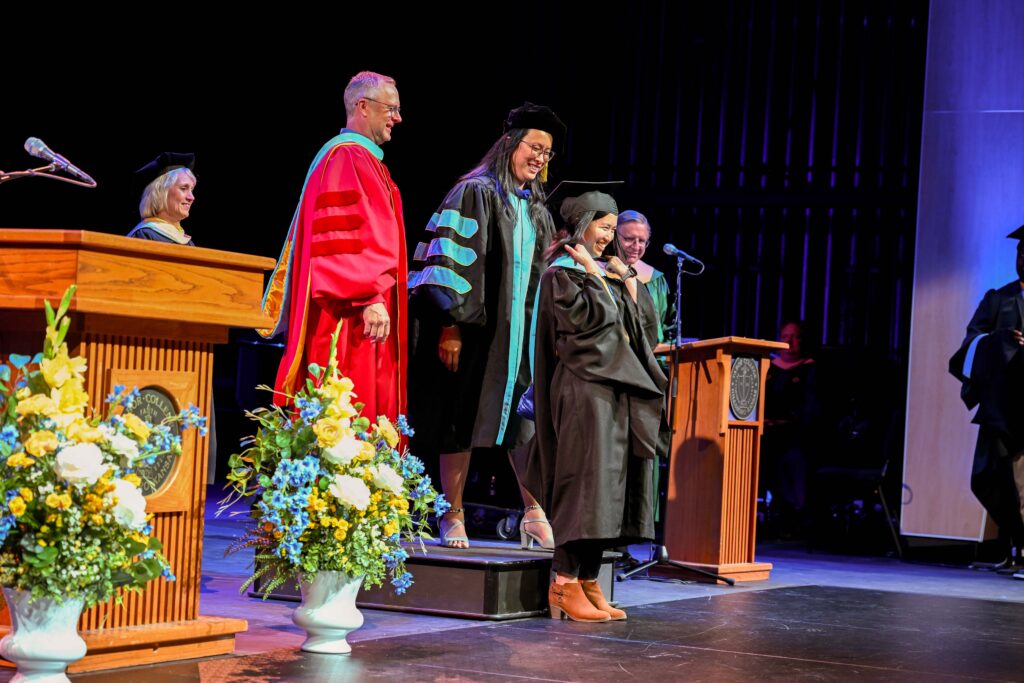
Seven students were what was asked of David Stevens, Ed.D., at the outset of the Master of Education in Neuroscience and Trauma program. Launched in summer 2021, the program more than quadrupled the initial goal with 34 students in its first cohort.
That number has held steady, and in the current cohort, 47 students have the program ‘bursting at the seams.’
Originally built to equip teachers with instruction in neuroscience and psychology, the M.Ed. has expanded into careers such as social workers, police officers, pastors, therapists, and parents raising foster or adopted children.
“Often, we see students looking for trauma-only programs, but then are caught off guard when they see our degree name,” Stevens said. “They check if it’s for teachers only as an M.Ed., but when we share the growth, we’re seeing people from so many professions who live or work alongside survivors of trauma.”
The program’s growth has led to multiple start dates, which now include January and May. Starting in fall 2022, a Certificate in Neuroscience and Trauma began for continuing education units (CEUs) and other professional development courses.
Each full-time, part-time, or adjunct faculty member who began teaching at the program’s inception is still instructing. They’ve added two more over the past year, bringing that total to 11.
Over the fall, Tabor also introduced its first course through the degree that is catered to first responders. The shared belief among M.Ed. faculty is that this program has made a global impact in equipping students to walk alongside trauma survivors.
“It’s not just a degree to further your career, it’s a degree to be better for other people,” Stevens said. “If you can gain those skills, that’s life work. The program perfectly aligns with the mission of Tabor and who we are called to be as followers of Christ. I feel so fortunate to be a part of this.”
New entrepreneurial ventures were created from the program when a student from the first cohort brought her training back to her school district, and her superintendent agreed to implement it. That also included the addition of a safe room.
Stevens originally aspired to start the program at prior institutions, but as he later discovered, the no’s he was given were because of how God planned to bring the program to Tabor and central Kansas.
“There are times when I sit back and pinch myself,” Stevens said. “All I did was present my idea for this program, and now I get to sit back and watch God work miraculously through the lives of our students.”